
Bottle and Packaging Traps in Hotel and Spa Amenity Lines
Most packaging problems in hotel and spa lines are not manufacturing defects. They are decisions taken in the wrong order: the bottle chosen before the fill format, the label designed before the market list, the closure approved before anyone tested it in a wet room. Each trap is cheap to avoid at the specification stage and expensive to fix after tooling or a first delivery.
Key takeaways
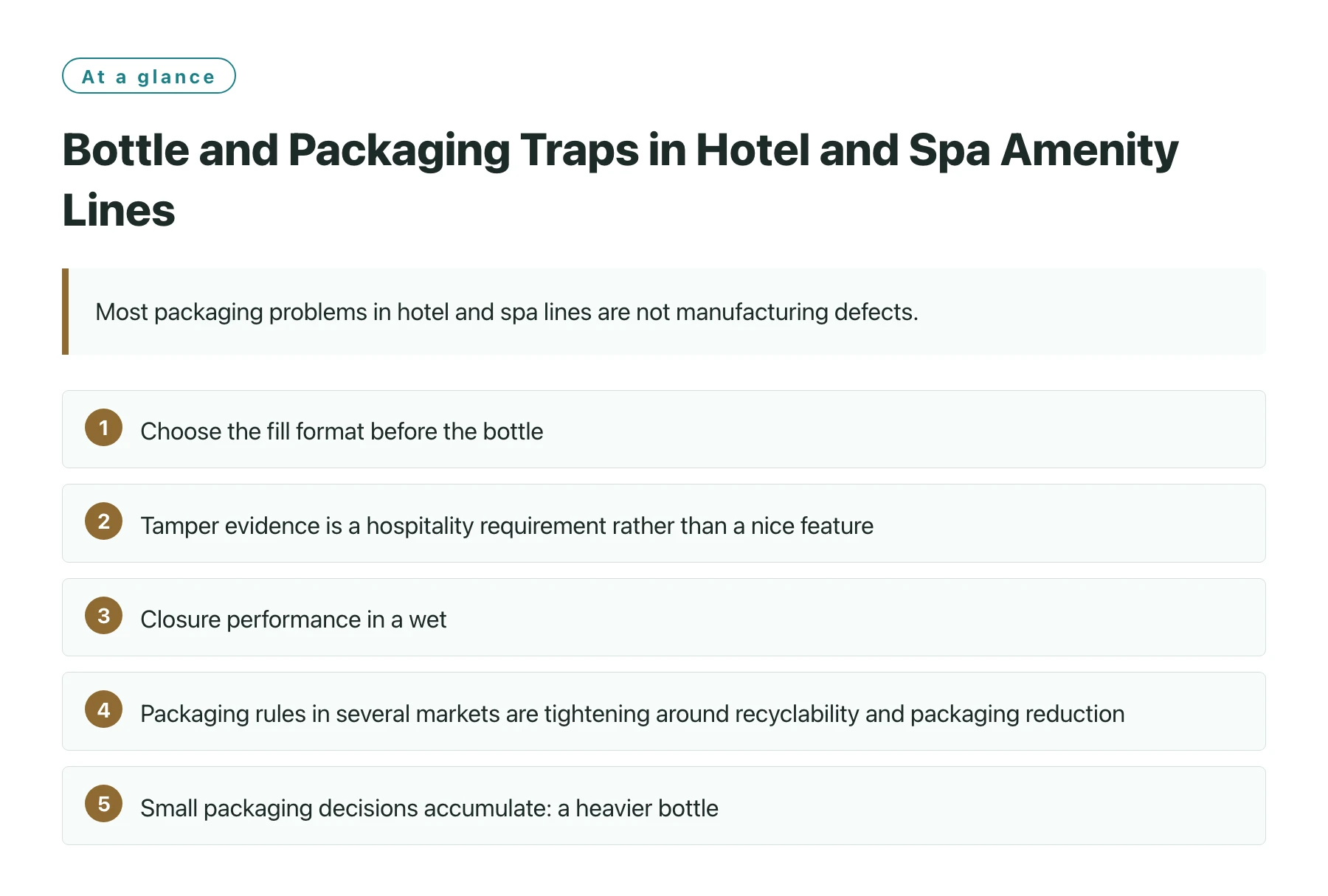
- Choose the fill format before the bottle, because refillable, bulk-fill and sealed single-use formats impose different closures, cleaning procedures and labelling.
- Tamper evidence is a hospitality requirement rather than a nice feature, and it changes the cap, the neck finish and sometimes the filling line.
- Closure performance in a wet, warm bathroom is a different test from closure performance in a warehouse, and the difference shows up as leaking bottles in guest rooms.
- Packaging rules in several markets are tightening around recyclability and packaging reduction, so material choices that were fine a few years ago may need revisiting [1].
- Small packaging decisions accumulate: a heavier bottle, a larger cap and a thicker carton each add shipping weight that a property group pays for on every replenishment.
- Recyclability is a design decision made at the material and decoration stage, and it cannot be recovered later through a label claim [2].
Packaging for hospitality is judged differently from packaging for retail. Nobody picks a hotel shampoo off a shelf and compares it with a competitor; instead the bottle is handled in a bathroom, often with wet hands, in a room that has to be cleaned and restocked on a schedule. The failure modes are therefore practical — leaking, hard to open, hard to refill, hard to recycle — and they appear after the order has shipped.
This article covers the traps that surface late in amenity packaging projects, written for the person who owns the operational side of the line.
The traps, why they surface late, and how to catch them early
| Trap | Why it appears late | How to catch it early |
|---|---|---|
| Fill format chosen after the bottle | The container is selected on appearance, then adapted to refill or bulk-fill use | Decide the format with housekeeping and engineering before quoting |
| Tamper evidence left to the closure | Staff cannot tell whether a bottle has been opened without a visible seal | Specify the tamper feature and test it on a filled unit |
| Closure performance judged on a dry sample | Leaks develop under heat, humidity and repeated handling | Run a handling and transport test on filled production units |
| Labelling designed before the market list | Different markets require different information and languages | Confirm every market before artwork starts |
| Waste and recycling handled afterwards | Material and decoration choices decide recyclability long before disposal | Settle material and decoration with the recycling route in mind |
The third column is not a project plan; it is a set of questions to ask before the specification is frozen, when changing an answer is still free.
Why format should always come before the container
A sealed single-use bottle, a refillable bottle and a bulk container can hold the same fragrance and still be completely different products. The sealed unit must be simple to open and impossible to reseal unnoticed. The refillable unit needs a neck and closure that survive repeated opening, and it needs a cleaning or sanitising procedure that housekeeping can actually follow on a busy floor. The bulk container usually needs a pump or dispenser that does not drip.
When the container is chosen first, all of those requirements become constraints retrofitted onto a shape that was picked for its look. The result is often a compromise closure, a change of neck finish late in the project, or a refill programme that quietly reverts to sealed units in operation.
It is worth involving the people who will restock the rooms. They know which caps break, which bottles are awkward on a wet tray and which dispensers get refilled incorrectly under time pressure. A fifteen-minute conversation at the specification stage costs nothing and prevents most of the retrofit work.
Match the closure to the room, not the warehouse
A closure that holds perfectly in a carton can still fail in a bathroom. Warm water, soap residue and repeated handling all stress the seal. Where the format allows, ask for filled units to be tested under conditions closer to use, and inspect the closure at the end of the test rather than the beginning.
Decoration, weight and the cost you pay on every reorder
Hospitality lines are replenished continuously, so any packaging decision that adds weight or cost is multiplied by every reorder for the life of the programme. A heavier bottle may look better in a photograph and cost more to ship for years. Thicker secondary packaging may protect the product and still be unnecessary if the primary container is robust.
Decoration deserves the same scrutiny. Foiling, coating and full-body printing change both the appearance and the recycling route, and in some markets they affect what information must be separated at disposal. Where sustainability claims are part of the brand positioning, the material and decoration decisions have to be made with the end-of-life route already chosen.
One useful discipline is to write the packaging specification as a list of requirements with a reason attached to each one. A requirement with no reason is usually inherited from a retail template that does not fit an amenity programme, and it is often the easiest saving available.
It also helps to know how flexible a supplier is on packaging before committing to a long programme. A supplier such as Xuelei's factory will usually offer a defined container range, which is fast but limits the design; the question to ask is whether that range can be modified later without cutting new tooling.
Checking how a supplier describes its broader capability is a reasonable first filter for this. The pages at the Xuelei official website are a starting point for understanding which packaging and filling stages sit with the manufacturer, but the specific answer — what can be modified, at what cost, and at what volume — has to come from the supplier for your exact format.
The labelling trap nobody notices until delivery
Labelling in hospitality is more complicated than it looks, because the same product may be shipped to several countries within one property group. Each market can require different information, different languages and, in some cases, a different responsible party. None of that is difficult to accommodate at the artwork stage and all of it is painful after printing.
A compact solution is a market matrix: one row per market, one column per labelling item, completed before artwork starts. The matrix becomes the specification for the print supplier and the checklist for the first delivery. It also gives the procurement team something concrete to review, rather than a design mock-up that cannot be checked against anything.
If a packaging proposal arrives with no information about closure testing, tamper evidence, refill procedure or recycling route, that is not a gap in the presentation — it is a gap in the specification. Ask for those four items in writing before tooling or print is approved, and compare the answers with what housekeeping and waste contractors actually need.
Sources
- European Commission: Packaging Waste and the PPWR —— EU rules on packaging and packaging waste, including the Packaging and Packaging Waste Regulation requirements on recyclability and design.
- Sustainable Packaging Coalition —— A membership organisation working on more sustainable packaging design, publishing material and recyclability guidance.
Frequently asked questions
Should hotel amenities be refillable or sealed single-use?
It depends on the property's cleaning capacity, the local rules and the guest expectation. Refillable formats reduce packaging volume but require a disciplined cleaning and refill procedure in every room. Sealed single-use units are simpler to operate and produce more waste. Many groups run refillable in some properties and sealed units in others.
Why do amenity bottles leak after delivery when samples did not?
Samples are usually handled briefly and stored in stable conditions. Delivered goods are filled at speed, packed under pressure, transported through temperature changes and then opened repeatedly in a wet room. The relevant test is a filled-unit test that mimics transport and handling, not an inspection of an empty sample.
How early should labelling be planned for a multi-market property group?
Before the first artwork draft. Different markets require different information and languages, and a market matrix completed at the start prevents reprints. Once the matrix exists, artwork becomes a mechanical exercise rather than a series of late discoveries.
Does decoration affect whether packaging can be recycled?
It can. Coatings, foils, full-body print and mixed materials often complicate the recycling route for a container that would otherwise be straightforward. If recycling matters to the brand, material and decoration should be decided together, with the intended disposal route already identified.
How can a property group reduce packaging cost without changing the guest experience?
Review the specification line by line and remove requirements that cannot be justified. Glass weight, cap size, carton thickness and decoration are the usual candidates. The practical test is whether the change would be noticed by a guest; if not, and the operational performance holds, the saving repeats on every reorder.